
A sourdough starter jar you can actually read
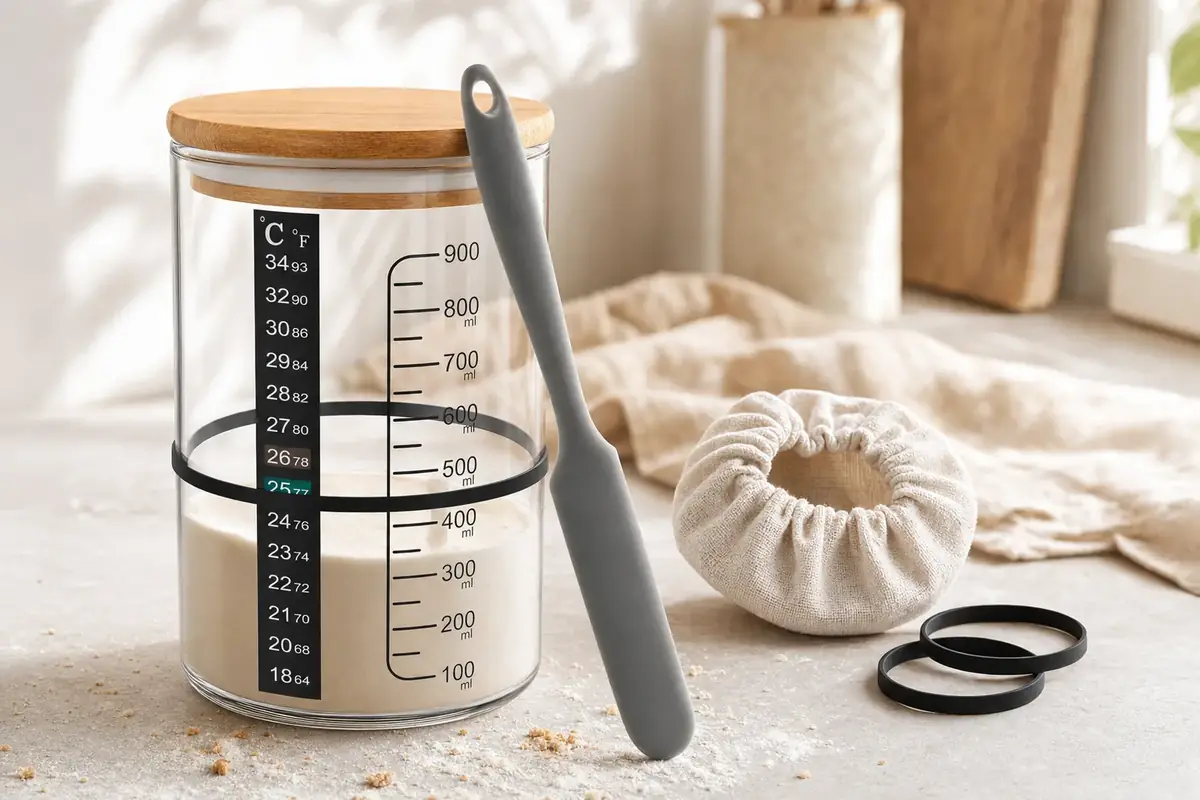
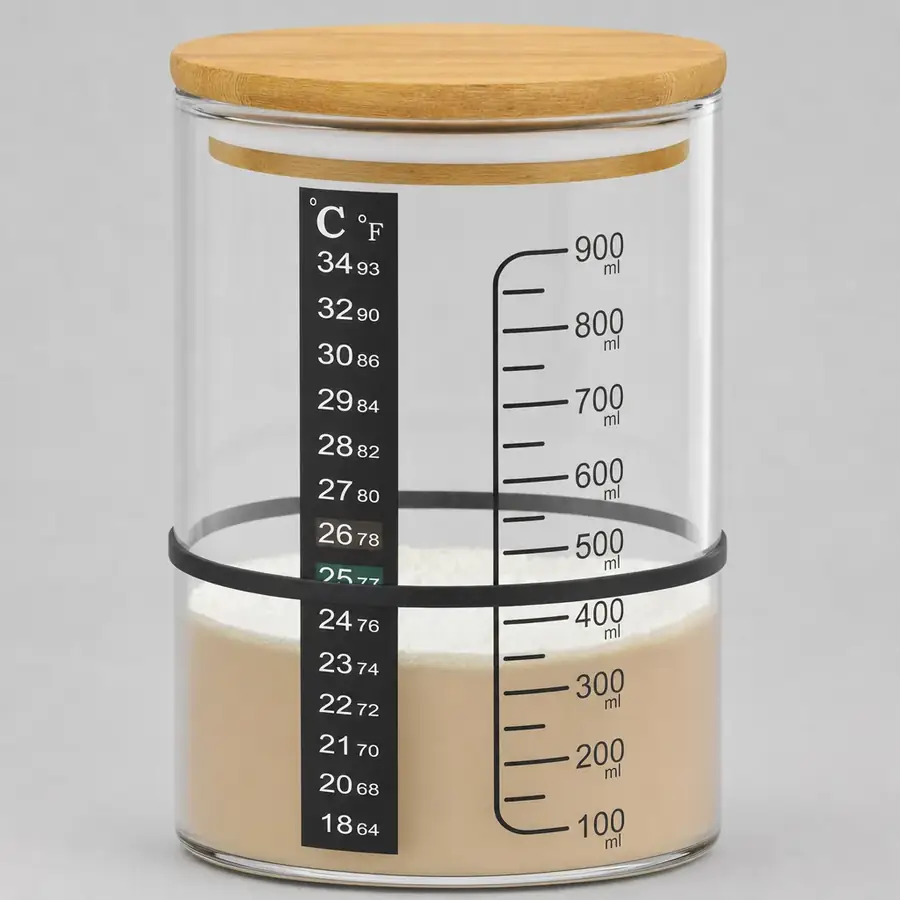
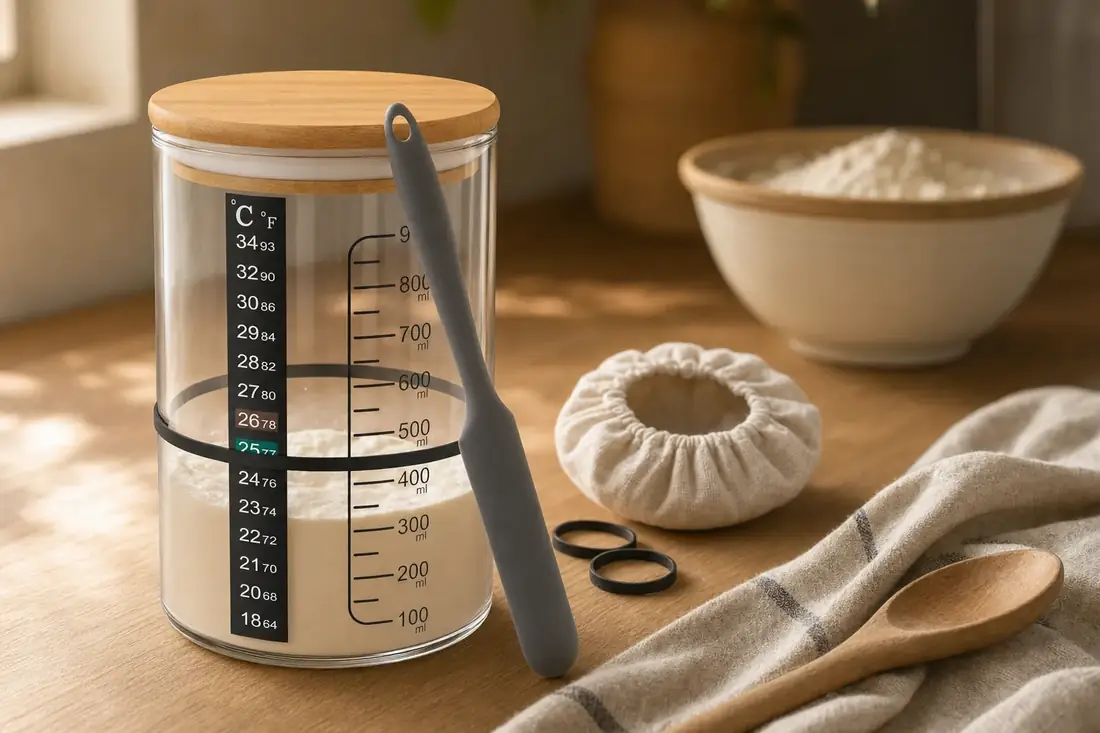
900 ml of clear graduated glass, a wooden lid, a stick-on thermometer and the small kit that goes around it. You see the rise, you see the temperature, and you stop guessing.
Most starters fail on information, not on flour
Ask anyone who gave up on sourdough why they stopped, and the answer is rarely the flour. It is that they could not tell whether the thing was working. Knowing it moved is not enough — you need to know how far and how fast, because those two numbers are the whole of what a starter is telling you.
The problem compounds because the two variables that matter most are invisible in an ordinary container. The first is the rise, which is meaningful only as a ratio: a starter that goes from 200 to 400 has doubled, and a starter that goes from 400 to 500 has barely stirred, even though the second one moved a bigger distance up the glass. Without a printed scale you are comparing heights, not ratios, and heights lie to you.
The second is temperature. Fermentation speed is far more sensitive to it than most bakers expect. The same starter, same flour, same feeding ratio, will behave like two different cultures in a 65 °F kitchen and a 78 °F one — and the bit of counter next to a window in February is not the same room as the shelf above the oven in July. If you do not know the temperature the jar is actually sitting at, a slow rise looks like a sick starter when it is simply a cold one.
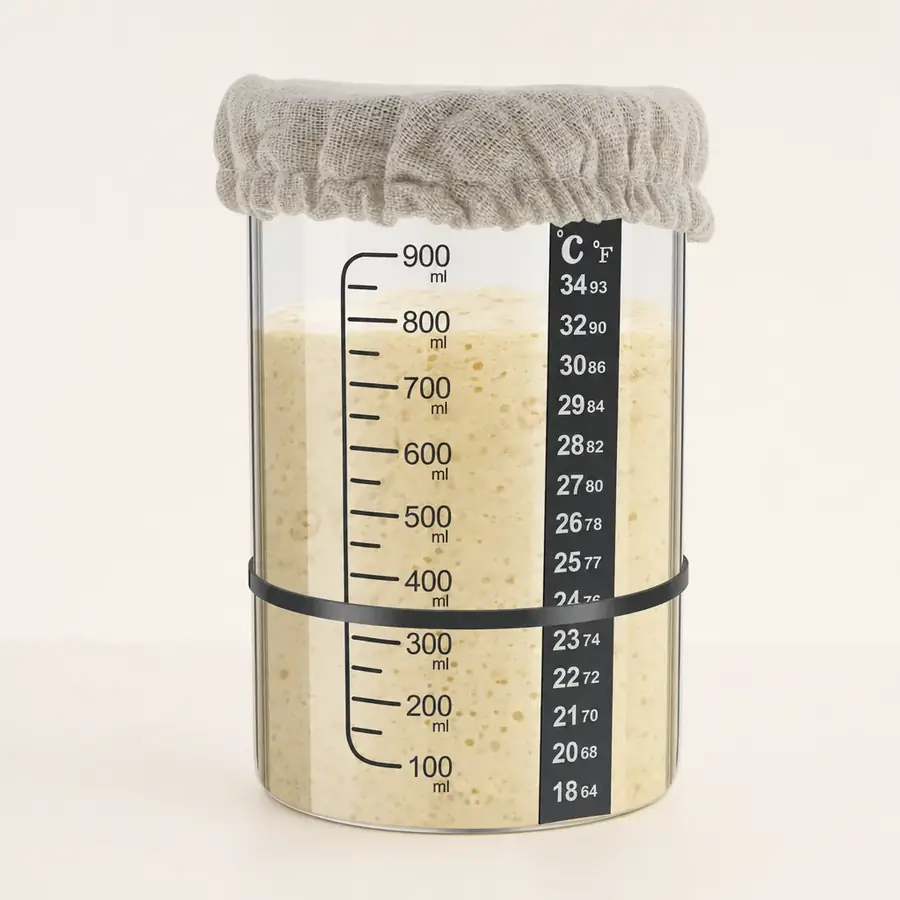
This jar solves both by putting the information on the container instead of in your head. The milliliter scale is printed down the glass from 100 to 900. The thermometer strip reads the temperature of the jar itself, not the room. And the elastic band gives you the one measurement neither of them can: where the level was when you walked away.
Three things you can read without opening the jar
A printed scale, 100 to 900 ml
The scale runs down the side in 100 ml steps. You read the level as a number instead of a height, which is what turns "it went up a bit" into "it doubled in six hours".
Marked in milliliters rather than cups, because a starter is a ratio and ratios are easier in tens. The glass is clear all the way round, so you can also read the texture: an active starter shows a webbed, bubbly structure against the wall that a cloudy container hides completely.
A thermometer on the side, 64–93 °F
The adhesive strip reads the temperature of the jar, not the room. It covers 64 to 93 °F, which spans a cold winter counter through to a proofing box.
This is the number that explains most "my starter died" messages. Below about 68 °F everything slows to a crawl and a healthy culture looks lifeless; above the mid-eighties it races, peaks early and falls before you get back to it. Reading it off the glass costs nothing and removes the guess.
A band you set at feeding time
Slide the elastic band to the surface right after you feed. Whatever the level does next is measured against a mark you set yourself, so the rise is unambiguous.
It sounds trivial and it is the single most useful item in the kit. It converts a vague impression into a fact, and it does it without a photo, a note or a timer. After a week of doing it you will know your own starter's rhythm well enough to plan a bake around it.
How much starter actually fits in 900 ml
Every guide tells you to leave "room to rise" and then stops. Since the jar's capacity is a fixed 900 ml, the room to rise is arithmetic, so here it is worked through. A healthy starter doubles reliably and triples when it is very active — so the question is which starting volume survives both without climbing over the rim.
| You start with | Doubled | Tripled | Verdict |
|---|---|---|---|
| 100 ml (about 3.4 fl oz) | 200 ml | 300 ml | Plenty of room. Best for a starter you feed in small amounts. |
| 200 ml (about 6.8 fl oz) | 400 ml | 600 ml | Comfortable at both. The everyday choice. |
| 300 ml (about 10 fl oz) | 600 ml | 900 ml | Fine when it doubles. A triple reaches the very top. |
| 450 ml (about 15 fl oz) | 900 ml | over the rim | The ceiling. A double just fits; a triple will climb out. |
| 600 ml (about 20 fl oz) | over the rim | over the rim | Too much. Even a modest rise escapes. |
The practical takeaway: 200 ml is the sweet spot and 450 ml is the hard ceiling. Above 450 you are relying on the starter not having a good day, which is a strange thing to hope for. If you regularly need more than that, you are baking at a scale that wants a second jar rather than a fuller one.
What the research actually says about starters
sourdough starters sequenced across four continents in the largest study of its kind, which found little evidence that a starter's community depends on where it lives
— Landis et al., eLife, 2021
of UK households bake at least once a week, and 20% at least once a month — home baking did not fade back to its pre-2020 level
— AHDB (UK) household baking survey, 2024
the temperature this jar's glass is rated to, which covers hot water and normal dishwashing (not oven use)
— Technical sheet, 2026
The eLife study is worth knowing about for a second reason: it found no meaningful geographic signature in starter communities. The folklore that a starter is defined by the city it lives in did not survive the data.
 What you get out of it
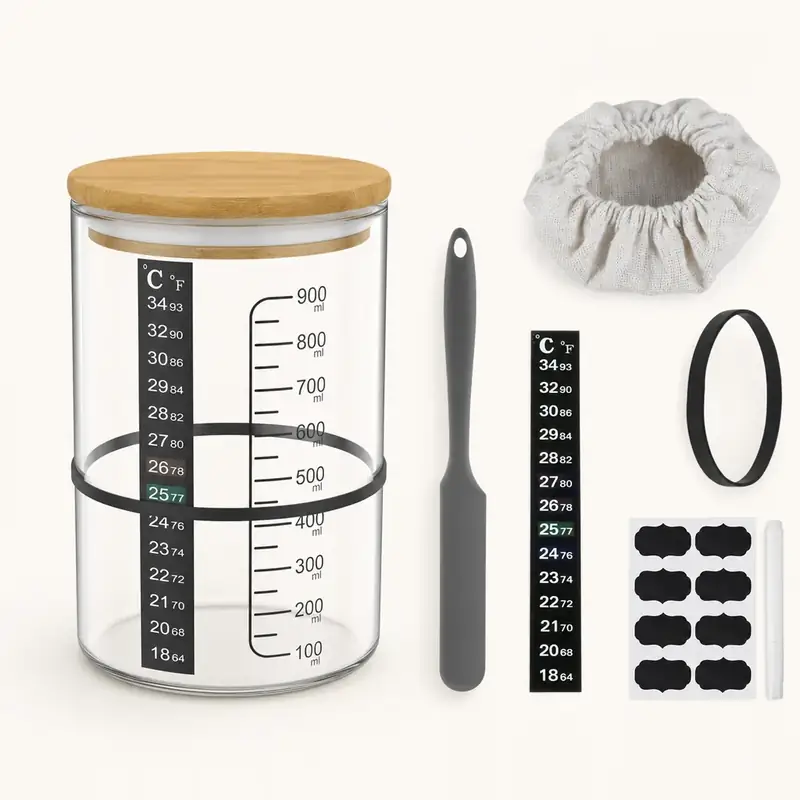
Six things you can read without opening anything
| What you want to know | How this jar answers it |
|---|---|
| How far did it rise? | Printed scale, 100 to 900 ml — a number, not a guess |
| How warm is it sitting? | Strip on the glass, 64 to 93 °F |
| Where was it when I fed it? | An elastic band you slide to the level |
| How active is the culture? | The bubble structure reads against the wall |
| How high did it peak while I was out? | The dried tidemark left on the glass |
| Has it separated? | Any liquid layer shows at a glance |
Six answers, none of which needs a lid lifted, a photo taken or a note written. That is the whole point of putting the information on the container instead of leaving it in your head. The 500-starter survey published in eLife in 2021 backs this up squarely: the variation between healthy starters is enormous, so comparing yours to a video tells you almost nothing. Your own numbers, read off your own jar, are the benchmark that counts.
Everything else worth knowing
How to choose between the two sets
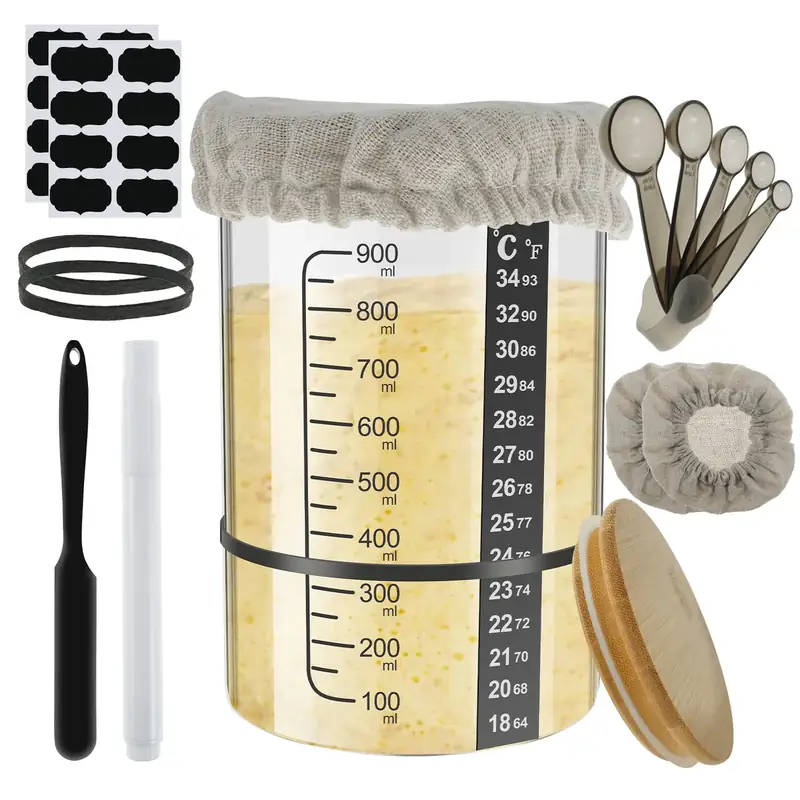
Both sets are built on the same jar, and that is the part that matters: 900 ml of graduated glass, a wooden lid, a silicone spatula, the thermometer strip, a sheet of chalk labels and the erasable pen. Whichever you pick, the day-to-day experience is identical.
The Complete Set differs in two ways. The consumables double — two cloth covers instead of one, two elastic bands, two label sheets — and it adds the five-piece measuring spoon set. That is the whole of it, and it is worth being precise because the difference is easy to overstate.
The doubling matters more than it sounds. The cloth cover is the item you wash most, and having a second one means the jar is never uncovered while the first dries. Same logic for the bands: one lives on the jar, one lives in the drawer for when the first perishes. If you feed by weight with a scale, the spoons will sit unused and the Essential Set is the sensible pick. If you feed by volume, or you are setting someone up who has never kept a starter, the spoons remove one more trip to another drawer.
A note on sizing, since it is the question that comes up most: the jar is 3.9 in across and 5.9 in tall. That is deliberately wide rather than tall. A narrow jar of the same capacity would show a taller column for the same rise, which flatters the numbers, and it would be much harder to reach into with a spatula. Straight walls and a wide mouth are what make it scrape clean.
For a fuller breakdown of what each piece does, the starter kit guide goes through the contents item by item. If the material is what you are weighing up, why glass covers it, and the fermentation jar page looks at the vessel itself. If you are still comparing options, container types sets them side by side, what makes a good starter jar goes through the five properties that matter, and the tools page covers what to buy first.
What is in each set
| Item | Essential Set | Complete Set |
|---|---|---|
| 900 ml graduated glass jar | 1 | 1 |
| Wooden lid | 1 | 1 |
| Silicone spatula | 1 | 1 |
| Stick-on thermometer strip | 1 | 1 |
| Erasable marker pen | 1 | 1 |
| Breathable cloth cover | 1 | 2 |
| Elastic band | 1 | 2 |
| Sheet of 8 chalk labels | 1 | 2 |
| Measuring spoons (5-piece) | — | 1 set |
Specifications
| Jar capacity | 900 ml (30 fl oz) |
|---|---|
| Jar size | 3.9 in across × 5.9 in tall (10 × 15 cm) |
| Jar material | Clear glass, graduated 100–900 ml, with a °F / °C scale |
| Heat resistance | Up to 302 °F (150 °C) |
| Lid | Wooden lid |
| Cloth cover | 3.7 in (9.4 cm) across |
| Elastic band | 3.4 in (8.64 cm) |
| Thermometer | Stick-on strip, 5.09 in (12.95 cm) long, 64 to 93 °F (18 to 34 °C) |
| Spatula | Silicone, 9.48 in (24.1 cm) |
| Labels | Sheet of 8 chalk labels with an erasable pen |
| Food contact | Rated for food contact. No substances of concern declared. |
Measurements are the spec sheet figures. Where a dimension is not published we leave it out rather than estimate it.
Rated 4.9 / 5 from 58 verified ratings
Three of the 8 written reviews we publish. The photos their authors sent are on the reviews page, each beside the review it belongs to.
"They are helping me a lot."
— Owen D., verified buyer
"Perfect. Just like in the photo. Very satisfied."
— Colin B., verified buyer
"The package arrived in good condition, they asked me for it for a school project and it works very well."
— Derek P., verified buyer
See all of them on the reviews page.
Why the same starter behaves like two different cultures
This is the single most common reason a starter gets declared dead. Someone feeds it, comes back eight hours later expecting the doubling they saw in a video filmed in a warm kitchen, finds barely any movement, and concludes something is wrong. Nothing is wrong. The jar is cold, and a cold culture is a slow culture, not a dead one.
The reverse trips people up just as often, and it is harder to spot. In a warm room a starter can rise, peak and collapse back down inside the window you were away. You return to a flat, slack surface and read it as failure, when in fact you missed the peak by two hours. The band tells you this happened: if the level sits below the mark you set at feeding time, it did not fail to rise — it rose and came back down.
Knowing which of the two you are looking at changes what you do next. A cold, slow starter wants a warmer spot and patience, not more flour. A starter that peaked early wants a cooler spot, a stiffer feed or a shorter interval. Without the temperature and the band you cannot distinguish them, and the usual response — feeding it more, more often — makes the second case worse.
The strip is deliberately a range rather than a precise instrument. It reads 64 to 93 °F because those are the temperatures a kitchen actually reaches, and because a starter does not care about a degree either way. What it cares about is whether it is sitting at the low end or the high end, and that is legible at a glance from across the room.
If you are starting from scratch and want the day-by-day version of all this, the guide to making a starter walks through the first two weeks, and feeding a starter covers ratios and timing once it is established.
 Living with it
 What the jar is like to use every day
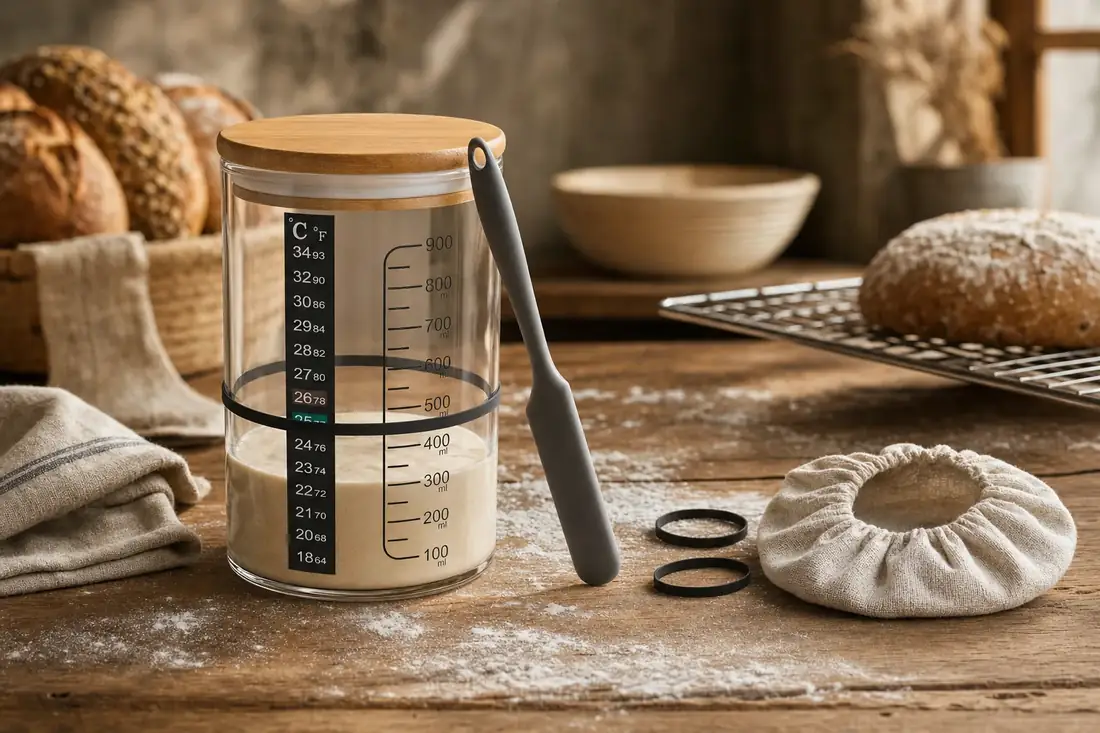
The straight walls matter more than they sound. A shouldered jar — the shape most jam jars have — traps a ring of starter under the curve where a spatula cannot reach. It dries, it darkens, and after a few weeks you are looking at a crust you have to soak off. With a straight-sided jar the spatula reaches every part of the wall in one pass, so the jar stays clean by default rather than by effort.
The wide mouth does the same job at the top. At 3.9 in across, you can get a hand and a spatula in without knocking the rim, which is what makes scraping down quick enough that you actually do it. Narrow jars of the same capacity look tidier on a shelf and are worse to use.
On covering: the wooden lid rests on top without a seal, which is what you want. A starter gives off carbon dioxide continuously, and a truly airtight lid builds pressure — at best it hisses when you open it, at worst it pushes starter out around the rim. When the culture is very active, the cloth cover and band are the better choice: they let gas out freely while keeping dust and fruit flies off.
Cleaning is mostly a non-event. Scrape and feed, week after week, and give it a proper wash every few weeks. Hot water and a little soap, dried fully before the starter goes back. The cleaning guide covers what to do when it has been left too long, which happens to everyone eventually.
If you keep your starter in the fridge between bakes rather than on the counter, the routine shifts and so does the headroom you need — storing a starter goes through both approaches.
Reviewed and updated August 7, 2026. See our standards.
Questions people actually ask
What size jar do I need for a sourdough starter?
Pick a jar with at least twice the room of your starter, and ideally three times. A healthy starter doubles in 4 to 8 hours and can triple when it is very active. This jar holds 900 ml, so a 200 ml starter has comfortable headroom and a 300 ml starter still fits when it triples.
What should a sourdough starter be kept in?
Clear glass with room to double, a scale you can read and a lid that lets gas out. This jar gives you all three: 900 ml graduated from 100 to 900, a temperature strip on the side and a wooden lid that rests on the rim. You see the rise, judge activity at a glance and spot any separation without opening anything.
Should the lid be airtight?
No. A starter releases carbon dioxide, and a sealed jar builds pressure. Use the wooden lid resting on top without pressing it down, or swap to the cloth cover and elastic band when the starter is very active. Both let gas escape while keeping dust out.
What do the elastic bands do?
You slide a band to the level of the starter right after feeding. When you come back, the distance between the band and the surface tells you exactly how far it rose, without guessing or comparing photos. It is the simplest way to learn your own starter's rhythm.
How do I read the thermometer strip?
The strip sticks to the outside of the glass and shows the temperature the starter actually sits at, from 64 to 93 °F. That matters because temperature drives fermentation speed far more than most bakers expect: the same starter in a cool room and a warm one behaves like two different cultures.
Is the glass safe for food and for hot water?
The jar is rated for food contact, with no substances of concern declared, and the glass is rated to 302 °F (150 °C). That covers hot water and normal dishwashing. It is not designed for the oven or for direct flame.
How do I clean it between feeds?
Most of the time you do not need to. Scrape the sides down with the silicone spatula and feed on top of what is there. Give it a proper wash every few weeks with hot water and a little soap, dry it fully, and put the starter back. The straight sides mean there is no shoulder for dried starter to hide under.
What is the difference between the two sets?
Both contain the same 900 ml jar, wooden lid, spatula, thermometer strip, label sheet and pen. The Complete Set doubles the cloth cover, the elastic band and the label sheet, and adds the five-piece measuring spoon set. If you feed by weight you may not need the spoons; if you feed by volume, they save you fetching them each time.
Stop guessing what your starter is doing
Free shipping, 30-day returns, and a jar that tells you where you stand.
Choose your kit →