
A fermentation jar built for one job: keeping a starter
"Fermentation jar" covers a wide family of vessels, from airlocked crocks for sauerkraut to demijohns for wine. A sourdough starter sits at the simple end of that family, and the equipment it needs is correspondingly modest — which is why an over-engineered vessel is not an upgrade here, just a heavier object with parts you will not use.
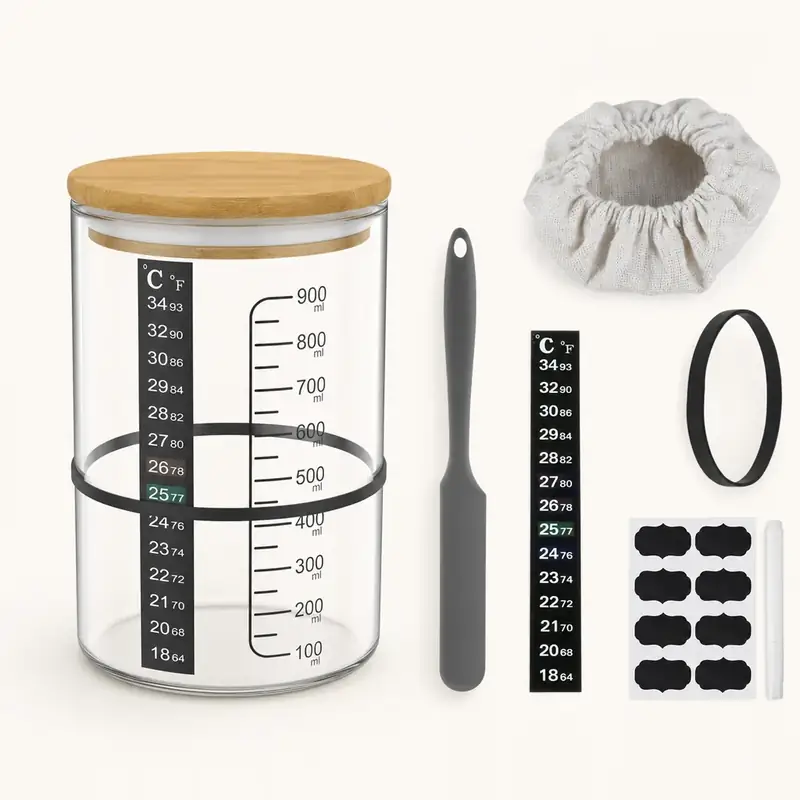
Everything you need to read, on the outside of the jar
A starter is a living culture and it communicates constantly — but only through the surface it sits behind. This jar is designed so that every signal it sends reaches you without opening anything.
| What you want to know | How this jar answers it |
|---|---|
| How far did it rise? | Printed scale, 100 to 900 ml, read as a number |
| How active is it? | Bubble structure visible through the wall, top to bottom |
| How warm is it sitting? | Strip on the side, 64 to 93 °F |
| Where was it when I fed it? | Elastic band you slide to the level |
| How high did it peak while I was out? | The dried tidemark left on the glass |
| Has it separated? | Any liquid layer shows at a glance |
Six pieces of information, none of which requires lifting a lid, taking a photo or writing anything down. That is the whole design brief, and it is why the vessel is clear glass with a scale on it rather than anything more elaborate.
Ordinary kitchen light does no harm to a starter, so there is nothing to protect it from. Sustained direct sun is worth avoiding for heat rather than light — and the temperature strip catches that before it turns into a runaway rise.
What "room to ferment" actually means in numbers
Every guide says leave headroom and stops there. Since the capacity is a fixed 900 ml, the answer is arithmetic. A healthy starter doubles reliably and triples when it is very active.
| Starting volume | Doubled | Tripled | Fits? |
|---|---|---|---|
| 200 ml (about 6.8 fl oz) | 400 ml | 600 ml | Yes, comfortably — the everyday choice |
| 300 ml (about 10 fl oz) | 600 ml | 900 ml | Yes, but a triple reaches the rim exactly |
| 450 ml (about 15 fl oz) | 900 ml | over the rim | The ceiling — a double only just fits |
So the rule of thumb "no more than half full" is right, and "a third full" is more comfortable. The graduated scale is what makes this actionable rather than theoretical — you can see the 450 mark and know not to cross it.
Why the lid must not seal
This is the one place where using a general fermentation vessel actively causes problems. Many are built around an airlock or a clamped gasket, both designed to hold pressure in while keeping air out. For a brined vegetable ferment that is exactly right. For a starter it is the wrong tool.
A starter produces carbon dioxide continuously and needs it to leave. Seal the jar and pressure builds — at best you get a hiss and a mess on the counter when you open it, at worst starter forces its way out around the gasket. The wooden lid here rests on the rim and lets gas escape on its own. When the culture is very active, the cloth cover and elastic band give even more airflow while keeping dust and fruit flies off.
There is a second reason, less obvious. A sealed jar traps moisture as well as gas, and the condensation runs back down the walls and blurs the very scale you bought the jar to read.
Designed around one job, and finished properly
Every choice in this jar points the same way: a starter, kept on a counter, read at a glance twice a day.
Straight walls. A spatula takes the whole side down in one pass, so the glass stays clear and the scale stays readable. There is no shoulder, no curve, nowhere for starter to dry into a crust.
A wide mouth, 3.9 in across. Room for a hand and a spatula without knocking the rim, which is what makes scraping down fast enough that it becomes habit rather than a chore.
A lid that rests. Carbon dioxide leaves on its own, so nothing builds up and nothing condenses back down the walls to blur the scale. When the culture is at its most active, the cloth cover and band open the airflow further.
Glass rated to 302 °F. Hot water and a dishwasher cycle are well within range, so cleaning is straightforward and the jar keeps its clarity year after year.
The result is a vessel you can leave on the counter and read from across the room, which is exactly what a starter asks of its container.
Temperature, turned into a number you can act on
Fermentation speed tracks temperature closely. The same culture, the same flour, the same feeding ratio will move at very different rates in a 65 °F kitchen and a 78 °F one — and that single variable explains most of the rises people find puzzling.
The strip on the side puts it in front of you. A slow morning stops being a mystery: the jar is cold, and a cold culture is a patient one, not a failing one. A starter that peaked and fell while you were out stops being a mystery too, because the band you set at feeding time is still there above the surface, telling you exactly what happened.
Once you can read the temperature, you can steer it. Move the jar to a warmer shelf and the rise comes forward. Move it somewhere cooler, or feed it a little stiffer, and it stretches out to meet your schedule instead of yours meeting its. That is the difference between keeping a starter and planning a bake around one, and it comes from a strip of adhesive film on the outside of the glass.
Numbers worth knowing
capacity, graduated in 100 ml steps, with a temperature strip reading 64 to 93 °F down the side
— Technical sheet, 2026
the temperature the glass is rated to, which covers hot water and normal dishwashing but not oven use
— Technical sheet, 2026
starters sequenced across four continents in the largest survey of sourdough microbiomes to date — it found little evidence that a starter's community depends on where it lives
— Landis et al., eLife, 2021
Where to go next
The main product page covers the scale, the strip and the shape of the walls in detail. If the material is your open question, why glass goes into it fully, and the starter kit page lists everything that ships with the jar. For daily use, see feeding a starter, storing one and cleaning the jar. New to all this? Start with making a starter. You can also read what buyers reported or see our standards.
Questions about fermentation jars
What makes a good fermentation jar for sourdough?
Room for the culture to double, a printed scale so you read the rise as a number, a temperature reading, and a lid that lets carbon dioxide out. This jar has all four: 900 ml of clear glass graduated from 100 to 900, a strip reading 64 to 93 °F, and a wooden lid that rests on the rim.
Does a starter need to be kept in the dark?
Not in a normal kitchen. Ordinary indoor light does not harm a starter. Direct, sustained sunlight is worth avoiding, mainly because it heats the jar and pushes fermentation faster than you planned — which the thermometer strip will show you before it becomes a problem.
Can I use this jar for other ferments?
Yes — the glass is inert, rated for food contact and rated to 302 °F. It is designed around a sourdough starter in particular: the graduated scale, the temperature strip and the feeding bands all serve that job, and they make it the easiest culture to keep on a counter.
How full should a fermentation jar be?
No more than half, and a third is more comfortable. In a 900 ml jar that means about 200 ml of starter for everyday use and 450 ml as an absolute ceiling — at 450 a doubling just reaches the rim, and a triple goes over it.