
A sourdough starter kit that earns every item in the box
This kit is built around the jar, because the jar is where the information is. Everything else in the box is there because it answers a question you will ask in your first two weeks: how far did it rise, how warm is it sitting, when did I last feed it, and how do I get it off the walls.
That gives you a set where every item earns its place — a 900 ml graduated jar you can read at a glance, a strip that puts the temperature in front of you, bands that mark your starting level, a spatula sized for the corners and labels that remember the date so you do not have to.
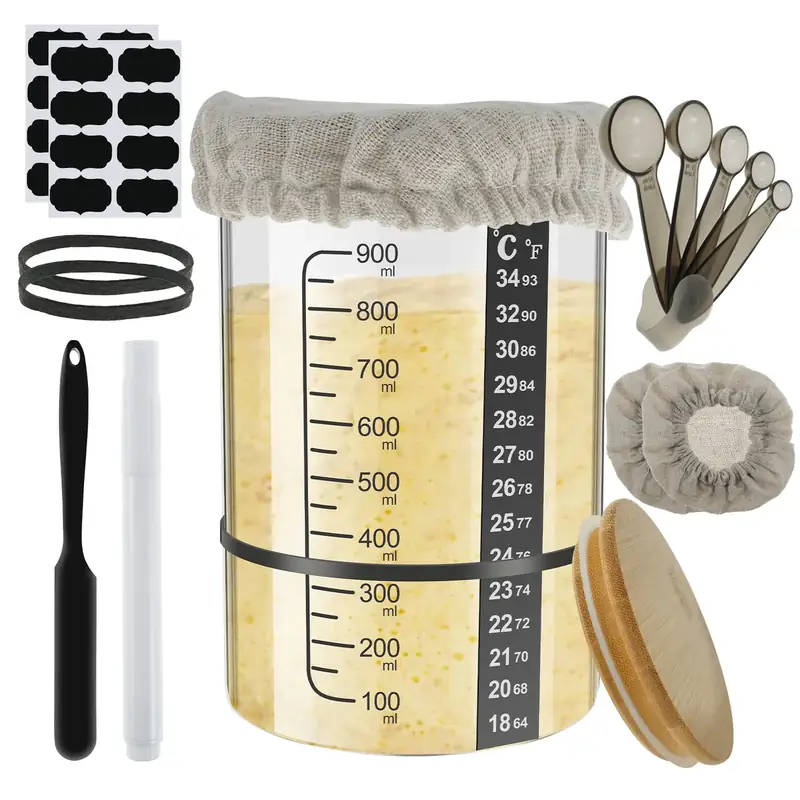
What is in the box, and why
Nine items, and each one exists for a reason you will meet within two weeks of starting.
The 900 ml graduated jar
Clear glass, 3.9 in across and 5.9 in tall, printed with a scale from 100 to 900 ml. The width is deliberate: a narrow jar of the same capacity shows a taller column for the same rise, which flatters the numbers, and it is far harder to reach into with a spatula. Straight walls mean there is no shoulder for dried starter to hide under — the single biggest difference between a jar that stays clean and one you end up soaking.
The wooden lid
It rests on the rim without sealing. This matters more than it looks: a starter gives off carbon dioxide continuously, and a genuinely airtight lid builds pressure until it either hisses at you or pushes starter out around the edge. A lid that sits on top keeps dust out and lets gas leave.
The cloth cover and elastic band
For when the culture is very active and you want maximum airflow. The band does double duty: as the cover's fastening, and as the marker you slide to the surface level right after feeding. That second use is the one that changes how you bake. It converts "I think it went up" into a measurement you can trust, without a photo or a note.
The stick-on thermometer strip
Reads 64 to 93 °F on the outside of the glass. It tells you the temperature the starter is actually sitting at, which is not the same as the room temperature and is the variable that explains most slow rises. A cold starter and a sick starter look identical until you can read the number.
The silicone spatula
9.48 in long, thin enough to reach the bottom corners and flexible enough to take the walls down in one pass. Scraping the sides at every feed is what keeps the jar from needing a proper wash more than once every few weeks.
The chalk labels and erasable pen
A sheet of eight labels and a pen that wipes off. Write the date and the feeding ratio on the jar itself. It sounds unnecessary until the first time you cannot remember whether you fed it yesterday morning or the day before.
The measuring spoons — Complete Set only
A five-piece set, from a tablespoon down to a quarter teaspoon. If you feed by weight on a scale you will not touch them. If you feed by volume, they save you fetching spoons from another drawer twice a day, which is exactly the kind of friction that ends a habit.
The two sets, item by item
Both sets share the same jar and the same core tools. The difference is narrower than most product pages would have you believe, so here it is in full rather than in adjectives.
| Item | Essential Set | Complete Set |
|---|---|---|
| 900 ml graduated glass jar | 1 | 1 |
| Wooden lid | 1 | 1 |
| Silicone spatula | 1 | 1 |
| Stick-on thermometer strip | 1 | 1 |
| Erasable marker pen | 1 | 1 |
| Breathable cloth cover | 1 | 2 |
| Elastic band | 1 | 2 |
| Sheet of 8 chalk labels | 1 | 2 |
| Measuring spoons (5-piece) | — | 1 set |
Two differences, then. The consumables double, and the spoons appear. The doubling is worth more than it reads on paper: the cloth cover is the item you wash most often, and owning a second one means the jar is never sitting uncovered while the first dries on the rack. The same logic applies to the bands — one lives on the jar, one waits in the drawer for the day the first perishes.
If you feed by weight and already own measuring spoons, the Essential Set gives you the identical daily experience. If you are buying for someone who has never kept a starter, the Complete Set is the one that does not send them hunting for a missing piece mid-feed.
Everything here does a job
Nine items, nine reasons. The kit is built tight on purpose: every piece answers a question you will actually ask in your first two weeks, which is what keeps the price where it is and the box a sensible size.
That focus is the point. A jar you can read, a strip that tells you the temperature, bands that mark your starting level, a spatula that reaches the corners, labels that remember the date for you. Put those five things on a counter and a starter becomes easy to keep — and the culture itself is free, just flour, water and about a week. The guide to making one takes you through it day by day.
How much starter the jar will actually hold
The capacity is a fixed 900 ml, so the useful question — how much can you start with — is arithmetic rather than opinion. A healthy starter doubles reliably and can triple when it is very active.
| Starting volume | After doubling | After tripling |
|---|---|---|
| 200 ml (about 6.8 fl oz) | 400 ml | 600 ml — comfortable |
| 300 ml (about 10 fl oz) | 600 ml | 900 ml — at the very rim |
| 450 ml (about 15 fl oz) | 900 ml — just fits | over the rim |
200 ml is the practical sweet spot and 450 ml is the hard ceiling. Above that you are relying on the starter having a quiet day. If you routinely need more, that is a second jar rather than a fuller one.
Some numbers worth knowing
starters sequenced across four continents in the largest survey of sourdough microbiomes to date — which found little evidence that a starter's community depends on where it lives
— Landis et al., eLife, 2021
of UK households bake at least once a week, and 20% at least once a month — home baking held its ground rather than returning to its pre-2020 level
— AHDB (UK) household baking survey, 2024
the temperature the jar's glass is rated to, which covers hot water and normal dishwashing (it is not an oven dish)
— Technical sheet, 2026
Where to go next
If you want the reasoning behind the jar itself rather than the kit around it, the main product page goes into the scale, the temperature strip and the shape of the walls. For the daily routine, feeding a starter covers ratios and timing, and storing a starter deals with the fridge-versus-counter question. If you are still choosing a container, why glass covers the material, and what size jar you need works through the volumes. You can also read what buyers reported or see our standards.
Common questions about starter kits
What should a sourdough starter kit actually include?
A jar with room to rise, a way to read the level, a way to read the temperature, a way to mark where you started, something to scrape with and a way to cover it that lets gas out. Anything beyond that is convenience rather than function.
Do I need a kit, or just a jar?
The jar does most of the work. What a kit adds is the measuring: the band that marks your starting level and the strip that tells you the temperature. Both are cheap items that change what you can tell about your starter, which is why they are in the box rather than sold separately.
Is a starter culture included?
No. These kits are the equipment, not the culture. A starter is flour and water and a week of your attention, and it costs nothing to begin — our guide to making one walks through the first two weeks day by day.
Which set should I buy as a gift?
The Complete Set. It doubles the consumables and adds the five-piece measuring spoons, so someone starting from nothing does not discover a missing piece halfway through their first feed. If they already bake and own spoons, the Essential Set covers the same ground.