
Why a glass jar is the right home for a sourdough starter
The container gets treated as a matter of taste, and it mostly is not. What you can read off it decides how quickly you learn your starter's rhythm — and that is the difference between guessing at a bake and planning one.
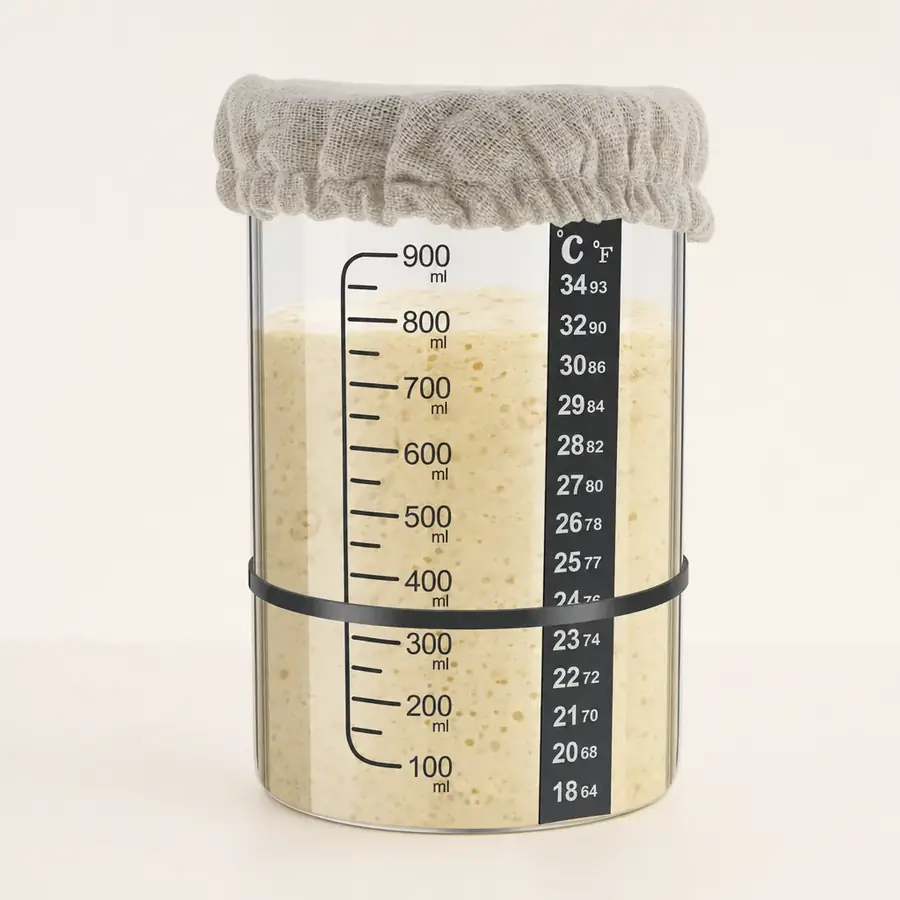
What glass gives you, point by point
| What you need from the container | What the glass delivers |
|---|---|
| See the level | Permanently clear, with a printed scale from 100 to 900 ml |
| See the texture | The bubble structure reads against the wall, top to bottom |
| Stay neutral with an acidic culture | Inert — nothing leaches in or out |
| Stay free of odors | Glass holds none, feed after feed |
| Stay smooth and easy to clean | No scratches for residue to sit in |
| Take hot water | Rated to 302 °F, dishwasher included |
Every one of those answers the same underlying question, the one you ask three times a day: what is it doing right now. That is what the material is chosen for.
Transparency is not a cosmetic feature
It is worth being precise about what you actually read through the side of a jar, because "you can see it" undersells it considerably.
You read the level, which on a graduated jar is a number rather than a height — and that distinction is the whole game. A starter that goes from 200 to 400 ml has doubled. One that goes from 400 to 500 has barely stirred, despite covering a bigger distance up the glass. Judging by height alone gets this backwards routinely.
You read the structure. An active culture shows a webbed network of bubbles pressed against the wall, coarse near the bottom and fine near the top. A sluggish one shows a dense, closed mass with a few large voids. This is the difference between "it rose" and "it rose well", and it is invisible in anything opaque.
You read the separation. A dark liquid layer on top — hooch — means the culture has exhausted its food and is telling you to feed it more often or keep it cooler. In a clear jar you spot it without opening anything. In an opaque one you find out when you lift the lid, which is usually later than you would have liked.
And you read the history. The dried tidemark left on the glass from the last peak shows you how high it got while you were out. That mark is a free measurement, and it only exists on a surface you can see through.
Shape matters more than material once you have chosen glass
Not all glass jars are equal for this job, and the differences are structural rather than aesthetic.
Straight walls. The side runs true from base to rim, so a spatula takes the whole wall down in one pass and nothing is left to dry on. The jar stays clean by routine rather than by effort, and the printed scale stays readable because nothing films over it.
Wide beats narrow at the same capacity. This jar is 3.9 in across and 5.9 in tall. A taller, narrower jar of the same 900 ml would show a bigger column for the same rise — which reads as more impressive and means nothing — and would be considerably worse to reach into.
The lid should not seal. Fermentation produces carbon dioxide without pause. A clamp-and-gasket jar is engineered to contain pressure, which is precisely what you do not want. A wooden lid resting on the rim, or a cloth cover held with a band, lets gas out while keeping dust and fruit flies off.
Glass does not age
This is the advantage that only shows up after a year or two, and it is the one that decides the question for anyone keeping a starter long term.
Glass in two years looks like glass today. The wall stays clear, the printed scale stays crisp, and the jar you read at a glance in month one is the jar you read at a glance in month thirty. Nothing about it degrades with daily use, hot water or the acidity of the culture itself.
That permanence is worth more than it sounds for an object you pick up twice a day, every day, for years. The whole value of this jar is that it shows you what your starter is doing — and a surface that stays perfectly clear is what keeps delivering that, feed after feed, long after the novelty of a new piece of kit has worn off.
The wide body helps in the hand too: 3.9 in across is easier to hold securely than a narrow vessel of the same capacity, and easier to set down one-handed while the other holds the spatula.
Keeping it clear
A glass jar earns its transparency only if you keep it transparent, and that takes less effort than people expect. Scrape the walls down with the spatula at every feed and the jar stays readable indefinitely. Skip it for a week and you are looking through a film of dried starter that defeats the entire point of choosing glass.
Every few weeks, give it a proper wash in hot water with a little soap, and dry it fully before the starter goes back in. Avoid abrasive scourers — they will not scratch the glass meaningfully, but they will dull the printed scale over time, and a scale you cannot read is a jar you cannot use. The cleaning guide covers the harder case, which is a jar that was left too long.
What the glass here is rated for
the temperature this jar's glass is rated to — comfortably covering hot water and normal dishwashing, though it is not designed for oven use or direct flame
— Technical sheet, 2026
capacity, printed on the side in 100 ml steps from 100 to 900 so the rise reads as a ratio rather than a height
— Technical sheet, 2026
starters sequenced across four continents in the largest survey of sourdough microbiomes to date, which found the variation between healthy starters to be far wider than folklore suggests
— Landis et al., eLife, 2021
That last figure is worth carrying around. Because healthy starters vary so much, comparing yours to a video is close to meaningless — your own numbers, read off your own jar, are the only useful benchmark.
Where to go next
The main product page covers the scale and the temperature strip in more detail, and the starter kit page goes through everything that ships alongside the jar. If size is your open question, what size jar you need works through the volumes with the arithmetic. For the day-to-day, see feeding a starter and cleaning the jar. Starting from nothing? Making a starter covers the first two weeks. You can also read what buyers reported, see our standards, or find out who we are.
Questions about glass jars
Why glass for a sourdough starter?
Because a starter tells you almost everything through the side of its container, and glass shows all of it permanently. It stays transparent for its whole life, does not scratch in normal use, holds no odors and takes hot water without trouble. The level, the bubble structure and any separation are all readable without lifting a lid.
Does the starter react with the glass?
No. A starter is acidic — that is the point — but glass is inert and nothing leaches into it or out of it. That is the reason glass and stainless steel are the two standard choices for long fermentation, and why acidic cultures are not stored in bare metal like aluminum or copper.
What shape of glass jar works best?
Straight sides and a wide mouth. A shouldered jar traps a ring of starter under the curve where a spatula cannot reach, and it dries there. A wide mouth lets you get a hand and a spatula in without knocking the rim, which is what makes scraping down quick enough that you keep doing it.
Can I use a glass jar with a clamp lid?
Only if you leave the clamp open. A starter releases carbon dioxide continuously and a sealed jar builds pressure — the gasket and clamp are designed to hold that in, which is the opposite of what a starter needs. A lid that rests on top, or a cloth cover, is the safer arrangement.