
A sourdough gift that ends up on the counter, not in a cabinet
Baking gifts have a failure mode. Someone receives a beautiful object, uses it twice, and it migrates to the back of a cabinet because it belongs to an occasion rather than a routine. The things that survive are the ones with a daily job.
A starter jar has the most daily job in the whole of sourdough. It is the first thing a baker looks at in the morning and the last thing they feed at night. Which is why it is the piece worth giving properly.
Why the Complete Set is the one to give
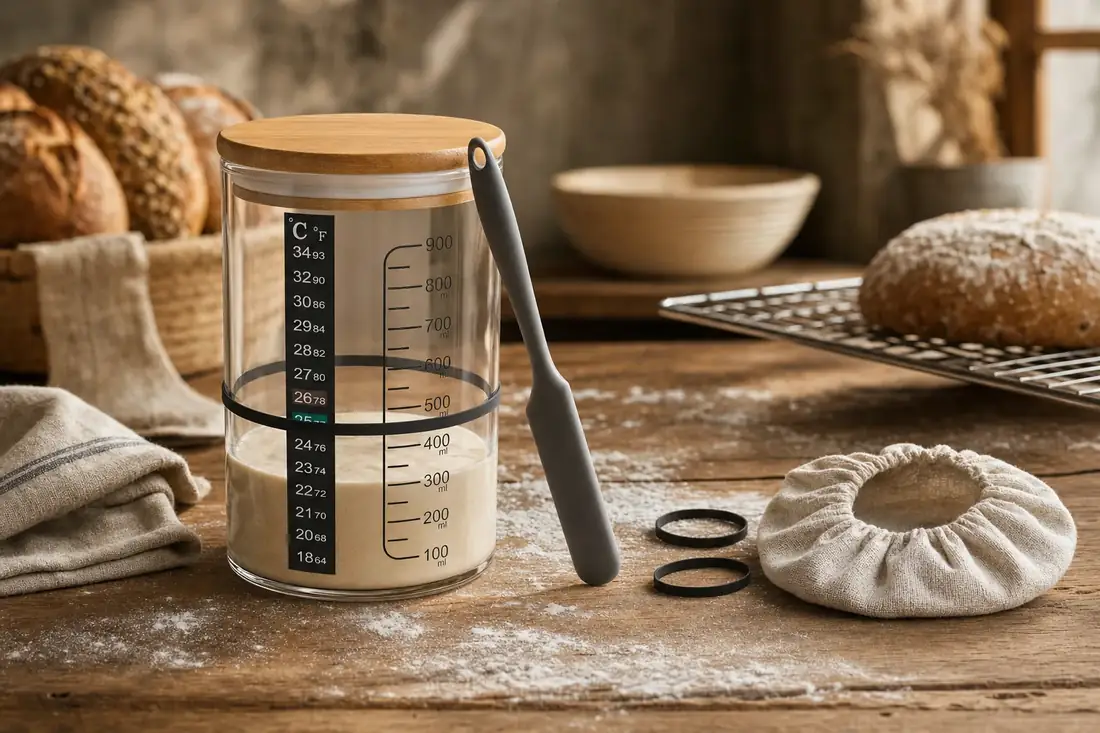
Both sets share the same 900 ml graduated jar, wooden lid, spatula, thermometer strip, labels and pen. The Complete Set doubles the consumables and adds the five-piece measuring spoons.
That difference matters more for a gift than for yourself. When you buy for your own kitchen, you already own spoons and you know what you can improvise. Someone unwrapping a kit does not — and discovering mid-feed that a piece is missing is exactly the friction that turns a new hobby into an abandoned one. The doubled cover also means the jar is never sitting uncovered while the first one dries.
| Item | Essential Set | Complete Set |
|---|---|---|
| 900 ml graduated glass jar | 1 | 1 |
| Wooden lid | 1 | 1 |
| Silicone spatula | 1 | 1 |
| Stick-on thermometer strip | 1 | 1 |
| Erasable marker pen | 1 | 1 |
| Breathable cloth cover | 1 | 2 |
| Elastic band | 1 | 2 |
| Sheet of 8 chalk labels | 1 | 2 |
| Measuring spoons (5-piece) | — | 1 set |
For someone who has never kept a starter
Beginners give up for one reason above all others: they cannot tell whether it is working. Everything about a young starter is ambiguous — it bubbles, then it does not, it rises overnight, then nothing happens for two days — and without measurements that ambiguity reads as failure.
The jar removes it. The scale turns "did it move?" into "it went from 200 to 400, so it doubled". The strip turns "why is it slow?" into "the kitchen is at 66 °F, that is why". The band turns "I think it rose" into a line on the glass. Three questions answered, in the first week, without any experience.
Pair it with our guide to making a starter, which takes the first two weeks day by day. Between the two, someone who has never done this has everything they need except the flour.
For someone who already bakes
Experienced bakers almost never buy themselves a proper jar. They keep their culture in whatever container was to hand when they started — and because it works well enough, upgrading it never reaches the top of the list.
That makes it a good gift precisely because it is the thing they would not buy. Someone who has kept a starter for years knows their culture by feel, and the first week with a printed scale is usually mildly surprising: the rise they call "doubling" turns out to be more, or less, than they assumed. Numbers do that.
What the recipient actually does with it, week one
Worth picturing, because it is the difference between a gift that starts a habit and one that starts a project.
Days one to three. Flour and water go in the jar, roughly equal parts, and the band goes to the level. Almost nothing visible happens, which is normal and is exactly where people without a scale start to worry. With one, they can see the level is unchanged rather than guessing at it — and the temperature strip explains why if the kitchen is cool.
Days four to seven. The first real activity. Bubbles appear against the glass, the level climbs and falls, sometimes dramatically and sometimes barely. The band records each attempt. This is the stretch where the numbers pay for themselves: a rise from 200 to 320 ml is genuine progress and looks like nothing at all if you are eyeballing it.
Days eight to fourteen. The culture settles into a rhythm — a reliable double in a predictable number of hours at a given temperature. Once someone knows those two figures for their own starter, they can plan a bake around it instead of hovering. That is the moment sourdough stops being unpredictable, and it arrives faster with a jar you can read.
Why not include a culture
It is the obvious thing to add to a gift set, and we leave it out on purpose.
A starter is flour, water and about a week. Raising one is the part people remember and talk about — the first morning it doubles is a genuinely satisfying thing, and receiving it ready-made removes exactly that. There is also a practical angle: a posted culture arrives dormant and needs several days of feeding before it is usable, which is very nearly the time it takes to raise one from scratch.
What the recipient cannot improvise is a jar with a scale printed on it and a strip that reads temperature. That is the part worth putting in a box.
Practical notes for gifting
Delivery. Free shipping, dispatched within 1 to 2 business days and arriving in 6 to 10. If it is for a dated occasion, order with two weeks in hand.
Returns. 30 days, free. If the recipient already has a jar they love, it goes back without argument.
Size. The jar is 3.9 in across and 5.9 in tall, so it sits comfortably on any counter and fits a standard kitchen shelf.
Food contact. Rated for food contact with no substances of concern declared, and the glass takes 302 °F, so it goes through a dishwasher without ceremony.
Presentation. Everything arrives together in one box, the jar protected in molded packaging. There is nothing to assemble and nothing to read before it can be used — the scale and the temperature strip are on the glass, so the object explains itself the moment it comes out of the wrapping. If you want to add a line to a card, "fill it a third full with flour and water" is genuinely all the instruction anyone needs to begin.
Numbers worth knowing
the recalculated average across the verified ratings we publish for this kit
— Doughkeep verified ratings, 2026
of UK households bake at least once a week and 20% at least once a month — home baking held its ground rather than fading back
— AHDB (UK) household baking survey, 2024
starters sequenced across four continents in the largest survey of sourdough microbiomes to date, which found little evidence that a starter depends on where it lives
— Landis et al., eLife, 2021
Where to go next
The starter kit page goes through the contents item by item, and the main product page covers the jar itself. See also what makes a jar worth owning, why glass, sizing and the full toolkit. For the recipient: making a starter and feeding one. You can also read what buyers reported.
Questions about gifting
Which set makes the better gift?
The Complete Set. It doubles the cloth cover, the band and the label sheet, and adds the five-piece measuring spoons — so someone starting from nothing is not missing a piece halfway through their first feed. Nothing to top up, nothing to order separately.
Does it come with a starter culture?
No, and that is deliberate. A culture is flour, water and about a week of attention, and it is more satisfying to raise than to receive. The kit is the equipment that makes raising one straightforward, and our guide walks through the first two weeks day by day.
Is it suitable for someone who has never baked?
Particularly suitable. The jar puts the two things a beginner cannot judge by eye — how far it rose and how warm it is — in plain numbers on the glass. That removes most of the guesswork that makes people give up in the first month.
Will it suit someone who already bakes?
Yes. Experienced bakers usually keep their starter in whatever jar came to hand, and the graduated scale plus the temperature strip is exactly the upgrade they have not got around to buying themselves.